
Funnel vs Cone Draining Simulation
Created: , Modified:Tags: C, Physics, Programming
I got asked this question some days ago.
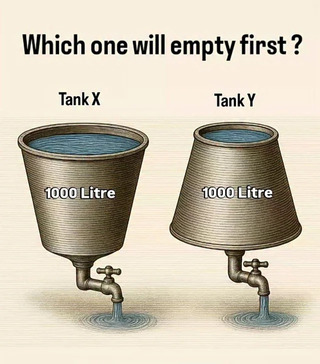
Image source: https://www.reddit.com/r/whatsyourchoice/comments/1op56hi/x_or_y_and_why/
This piqued my interest in simulating it, but I don’t have any fluid simulation knowhow. However, I know Bernoulli’s equation and Torricelli’s law, so I say let’s dissect this problem.
Let’s start with the faucet, assume that at a short time \( dt \) the volume coming out of it is a cylinder with volume \( dV \). We can compute \( dV \) through
\[ dV = \pi r_f^2 dh_f \]where \( r_f \) is the faucet’s radius. \( dh_f \) which is the height coming out of the faucet can be computed from
\[ dh_f = v_f dt \]where \( v_f \) is the velocity of the water coming out of the faucet that can be found through Bernoulli’s equation. Here we have the same atmospheric pressure \( (P) \), no hydrostatic pressure for the water at the top of the tank, and same density \( (\rho) \).
\[ \begin{align*} P + \frac{1}{2}\rho v^2 + \rho g h & = \text{constant} \\ P_f + \frac{1}{2}\rho_f v_f^2 + \rho_f g h_f & = P_t + \frac{1}{2}\rho_t v_t^2 + \rho_t g h_t \\ \frac{1}{2}v_f^2 + g h_f & = \frac{1}{2}v_t^2 \\ v_f & = \sqrt{v_t^2 - 2gh_f}. \\ \end{align*} \]with subscript \( t \) denoting the top of the tank. Now the lost volume is the same as the one lost in the funnel/cone. To find how much height the tank lost, we can assume that the radius of the cone is the same for a small \( dh \) (I did try without multiplying by 3 by assuming that it’s cylindrical but it’s more accurate this way)
\[ \begin{align*} \frac{1}{3} \pi r_t(h_t)^2 h_t - \frac{1}{3} \pi r_t(h_t-dh_t)^2 (h_t - dh_t) & = dV \\ \frac{1}{3} \pi r^2 h_t - \frac{1}{3} \pi r^2 (h_t - dh_t) & = dV \\ \frac{1}{3} \pi r^2 dh_t & = dV \\ dh_t & = \frac{3 dV}{\pi r_t(h_t)^2} \end{align*} \]where \( r = r_t(h_t) \) is the radius of the tank given the current tank’s height. For the radius of the tank, we can set it as a line with a slope \( (k) \)
\[ r_t(h_t) = k h_t. \]We now have the complete recipe to iteratively answer this question.
I’ll be using raylib to illustrate the simulations. Since I want to be able to deploy multiple funnels/cones at once, I’ll create a struct that contains its information.
struct Funnel {
	float rTop;
	float rBot;
	float rFaucet;
	float h;
	float k;

	float vTop;
	float vBot;
};
Then I can fill in the struct like so
unsigned int fps = 60;
unsigned int dtMult = 100;
unsigned int timeMult = 16;
float g = -9.81f;
float dt = 1.0f/fps/dtMult;

float initRTop = 150.0f/100.0f;
float initRBot = 40.0f/100.0f;
float initVTop = 0.0f;
float rFaucet = 3.0f/100.0f;
float initH = 120.0f/100.0f;

float calcSlope(float rTop, float rBot, float h) {
	return h / ( rTop - rBot );
}

// Init funnels
struct Funnel funnel1 = {
    initRTop,
    initRBot,
    rFaucet,
    initH,
    calcSlope(initRTop, initRBot, initH),

    0,
    sqrt( - (2*g*initH) ),
};
struct Funnel initFunnel1;
initFunnel1 = funnel1; // For resetting

struct Funnel funnel2 = {
    initRBot,
    initRTop,
    rFaucet,
    initH,
    calcSlope(initRBot, initRTop, initH),

    0,
    sqrt( - (2*g*initH) ),
};
struct Funnel initFunnel2;
initFunnel2 = funnel2;
Then update the funnels’ parameters using in a loop until h = 0.
void updateFunnel(struct Funnel *f, float dt) {
    float dhCylinder = f->vBot * dt;
    float dV = cylinderVolume(f->rFaucet, dhCylinder);

    float dhCone = 3 * dV / (f->rTop * f->rTop * M_PI);;

    f->h -= dhCone;
    f->h = max(0, f->h);
    f->rTop = f->rBot + (f->h/f->k);
    f->vTop = dhCone / dt;
    f->vBot = sqrt( pow(f->vTop, 2) - (2.0f * g * f->h) );
}
Here’s the result
The initial values I chose are based on this real experiment by Heterodox’s measurements. In the comments section, Heterodox said that tank X drained for 177 seconds and tank Y for 277 seconds. From my simulation tank X drained roughly for 119 seconds and tank Y drained for 239 seconds. It seems close enough for me with the usual justification of friction not being accounted for in this simulation.